Showing posts with label leaving South Africa. Show all posts

Sunday, March 10, 2013

Dumisani


Dumi and Mario
Last night we delivered the Toyota Camry we have been driving for the past six years to its new owner: Dumisani.

It was after a day (a week - a month) filled with non-stop activity of saying goodbye before we leave South Africa.

Mario and I are staying with the Wiggills (Terry and Bonnie) before we board a plane on Wednesday; our house is a mass of boxes and crates, a state of disarray that is unlivable.
Back to last night - we had arranged to drop off the car with Dumisani so Terry lent us his bakkie (pickup)  to do it.

Dumisani, Dumisani, Dumisani!  That's how I greeted him for years.  His name means "Praise" - specifically to God.  His mother, when he was born praised God for a fine young boy to carry on the family name, his life became a praise to God.

We met him and his wife Monica when we first got here.  Monica and I clicked, fought,  feasted and hung like real gal-pals; hailing from different cultures that made us always love but never fully understand one another.

Dumi and Mario had a steady, Men-of-God relationship.  When it was time for us to have a service in Diepsloot, Dumi and Mario teamed to reach the community with the Gospel; the full Gospel. We worked side-by-side, strategized and hosted many events together.   For all who have built a church, you understand the day-to-day bonding that becomes teamwork and friendship at the same time.  Prayer takes on a new level; faith is a shared something.

Six years of close friendship; not just obligation, but friendship that endured the highs and lows that all friendships go through. When Monica died last year, we all grieved deeply together....

Last night we said goodbye.

We handed off the keys to the car and insisted we would be back; he would come to us; this was just "see you later"...etc, etc, etc.

I kissed the top of the kids heads and made my way back out to the car.

"Are you leaving this week?" Timna, Dumi's five year old daughter asked me.

"Yes, honey," I smiled.  I have learned how to smile during goodbyes.

"Will you come back?" Lebongo asked.

"Definitely this year," I said.  God willing....

Dumi walked us out to the car, his figure lit up by the street lamp in front of his house.  I turned back to say goodbye, lifting my hand to wave.  I saw him - in my mind's eye I still see him - lit up and waving.

We drove back to the house, wordless.  Tears on our faces.

These goodbyes are killing me.


Tuesday, March 5, 2013

walk


There is a saying in the USA – “March comes in like a lion and goes out like a lamb.”  The weather in the Northern Hemisphere is stormy, wild and windy at the beginning of March – a lion.  By the time the month is ending, there are flowers appearing in trees, bulbs emerging from the ground and sun peeking through the clouds – a soft lamb signifying the beginning of spring.

I live in Africa.

I woke up this morning in a sweat.   My room has a ceiling fan and no air conditioning.  March (in Africa) comes in like hovering sun with sunglasses on and goes out the same way.  The summer here never knows when it’s time to leave.

As soon as I rose I showered, drank a cup of coffee and put my dogs, Zuzu and Peaches on their leashes.  They flipped out.  Normally their walk is after lunch or in the early evening (depending on how hot it is).  


We walked a familiar path, one I’ve grown accustomed to living here in Northriding.  It is 3.7 kilometers and it circles the property where we stay.  It is breathtakingly beautiful. 

I’ll show you. 

As you exit our gate there is a wide open field with tall grass in the summer.  It’s where moles and ferrets hide and the dogs love to dart out and see if anyone is there.  It’s a wild place that is fun to run around in.  Once a large jackrabbit bounded off, scaring our dogs, the first time they haven’t chased something.


We turn the corner and walk downhill, toward the blessing tree.  Mario and I believe that every bird you see is like God saying “Look, here’s how much I love you.  This is what I created for you!”  The blessing of seeing birds reminds us that everywhere are God’s blessings, small and large.   


The blessing tree is a large willow, situated happily over a pond.  It is filled with the nests of LARGE birds – the cranes, egrets and waterfowl nest there.  Some have nests in the branches, some at the base.  There is squawking and crying coming from its branches and in the summer I stop and look at them.  How come some places are FILLED with God’s blessings like this? 


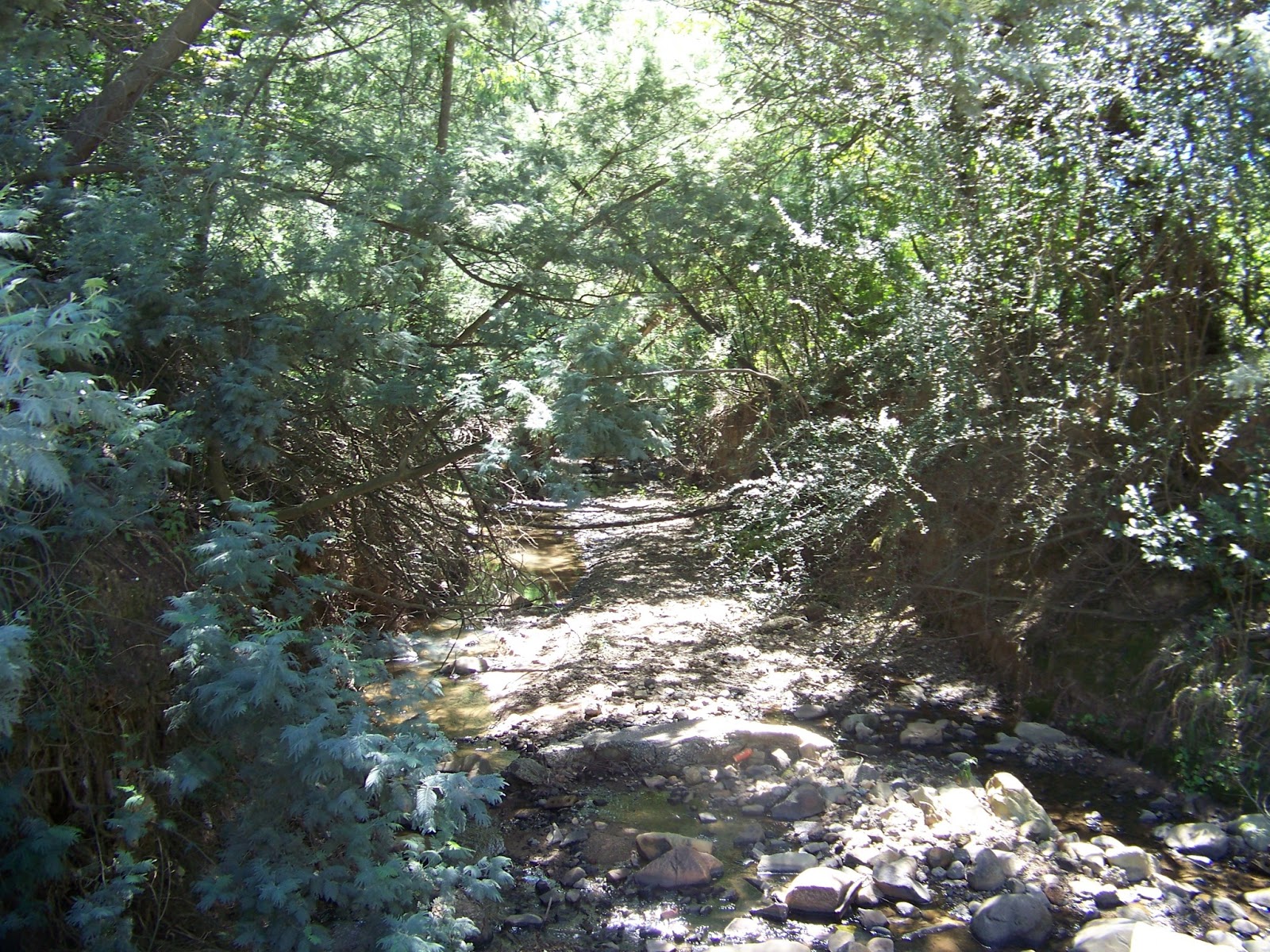
Turn the corner again and there is a creek at the bottom of the hill.  It is overgrown and wild, framed by trees that don’t belong in South Africa.  The creek sometimes has things in it like bottles or bags.  That makes me sad, but it is a shady spot and we stop and watch for frogs or lizards or something.

From there we begin a slow incline, no shade, only sun.  The dogs start to pant and move slower.  I guess I do too.  Some paths in our lives are a climb and have no shade, but they are necessary to walk through if you want to get home. 


The top of the hill is where we turn again, by the stables.  The horses are all gorgeous, and many times dressage practice is held there.  It is spectacular to watch, even though I know I’ll never be a part of that world. 

Halfway up the road are the homes to all of the ferocious dogs in Northriding.  They are big and scary looking and they get Z and P all stirred up, but I try to remain calm.  They are all fenced in and can’t hurt me. 

As I crest the hill, there is an idyllic portrait of Northriding.  It looks like a folk art painting, hills rising and falling, all in different shades of green.  It is a mountaintop moment, if the weather is good the view is stellar; if the weather is bad the view is stellar.  I pause here each time.

Our last turn takes us back to  Valley Road.   The first part is lined with gum trees and the wind (when there is one) ruffles the leaves and refreshes me.  It is shaded and easy. 
Next is the bridge with a creek that runs under it- the same creek that was wild and overgrown with shade (and sometimes polluted). 

My dogs love this side of the creek.  Freshwater crabs are just below the surface and Zuzu and Peaches growl at them.  If they ever did surface, the dogs would back away.  The crabs have nipped them before and they won’t make that mistake again.

The hill rises slowly and we approach our house.  Our neighbors have playful watch dogs and love to run up and down the fence line pretending to be disturbed by us.  They are the Mastiffs, gorgeous and playful.  I love this stretch. 

Our gate means we get to rest.  There is nothing as beautiful as coming home.  Today I fed them both a very nice meal early – their regular food mixed with good stuff that made them gobble it down.  They lap up water and look at me – they are suspicious why their treats all came before linch.  The answer pulls up to our gate in the form of a van driven by a man bearing a bill of lading. 

“Are they ready to go?” he asks me.  Why the hell is he smiling? 

Zuzu and Peaches will make the trip before us.  We packed them into little wooden boxes like they were going around the corner.  Instead they will fly over the Atlantic and arrive tomorrow in Atlanta to be poked and prodded by examiners making sure they have no fleas or worms. 
From there they will fly to Kansas City where my friend Denise and her daughter Gabrielle (good friends who Looooove our dogs) will keep them until we find a place in the USA.  Then we will “send for them” and Denise will come and deliver them to their new home. 

Theirs and ours. 

It was our last walk together today.  Our walking course has been a place for prayer, reminders of His promises and a time to think in a busy world.  I will miss it- I will miss the dogs desperately until I see them.


I put them into those crates today and said goodbye for at least a month.  They looked betrayed, as if they couldn't believe I was doing this to them.  Someone they trusted, someone they lived with closely now closing them into a tight space where they feel confined. 

It’s terrible to be put in a box you’re too big for.


Thursday, February 28, 2013

one


This is the last in a series I call
 "Top Ten Things I Would Have Never Said in America"  
I know it's long, but it's worth it.  

Me and Portia outside of the Junxion Center


1.  My best friend lives in the township.

When we first moved to South Africa it was to join a larger team that was already here – a team of people who worked into all of Africa- rugged folk that drove 4x4’s and said things like “All for Jesus” and lived it.
 
We did a “trial move” before we moved out here permanently- South Africa was a place we had only visited and we were advised to see if we could really live here.  The last nine posts have illustrated the “subtle differences” between life in the USA vs. life in South Africa.

On our trial move, we hunkered down in Joburg and started attending Junction Church, a cutting edge church that had its population split right down the middle: half were folk from Northern suburbs (the upscale neighborhoods that surround us) and half were from Diepsloot (the local township). 

I have not stated the obvious in my last posts: the disparity between rich and poor; white and black; have and have-nots here in South Africa was a bucket of ice water in my face.  It was shocking and terrible and most days I screamed within myself; demanding why the world around me wan't as shocked as I was. 

Junction Church seemed to be breaking through economic, social, and racial barriers more than any other church we  saw here.  We learned so much in that first year about the whole country.  Our teachers came mainly from the eldership. 

Portia and Thembe's White Wedding
The Junction eldership (the people who steered the church) were as diverse as its membership – I had never met a team so different in personality and giftings.  One of the elders, Thembe, we had previously met when we did a trip to Malawi.  Thembi and his family lived in the “church house” – a place that was on the site of our future church building.  

Thembe was from Zimbabwe, married to a young bride named Portia.  They had two children: Darely  (pronounced “Darrell”) and Ebenezer (Ebi) – young kids that clung close to their mother.  Portia was incredibly beautiful and it was easy to see that she and Thembe were very happy – despite having gone through an already challenging life together. 

“You are older than Portia,” Mario joked with him one day.  “How did you get her to marry you?” 

“I am secretly very wealthy,” Thembe joked back.  “Portia spends all my money.”

We relied on Thembe for something very important: he translated the Diepsloot culture for us.  Should we give money for someone who is asking us at church?  Should we not?  Why are funerals held on Saturdays?  What is the importance of tribal practices to the people vs. Christian beliefs?

Thembe never tired of our questions.  He had a slow, deliberate explanation for everything.  All the while he smiled. 

After our trial move we decided to come back and live in South Africa. 

When we came back to South Africa, six months later, Thembe was very sick.  He was remarkably thin and had contracted TB.  The whole church was concerned. 

“Thembe, you must get well,” Mario told him one day when he took him to the clinic.  “When you do, we’ll take you and your family to the ocean.”  Thembe and Portia had never seen the ocean – ever.

“When I get well,” Thembe said, weakly.  “We will go.”   

Six months later he weighed so little that Mario would carry him into the clinic when they went.  One day, during a visit, Thembe asked Mario a favor.

“I don’t think I’ll be able to see the ocean,” he whispered, weakly.  “But will you take Portia?” 

Mario came home weeping.  Two days later Thembe died.

All of Junction mourned.

A giant hole was left where he once was.  Then there was the issue of Portia – his young bride.  Darely and Ebi – his kids.  They buried him in Zimbabwe during the time of starvation under Mugabe’s rule, taking in supplies for the family.

We checked in with Portia every other day for weeks.  I would visit and just sit there, not knowing what to say.  I couldn’t very well ask her how she was.  She was messed up.

“What can I do for you?” I once asked her. 

“Pray,” she smiled.  “All we can really do for each other is pray.”

She meant it. 

Portia soon moved into Diepsloot.  The church house was being leveled in order to make room for the new building.  I wondered how she would do it. 

“See, there is the tap,” she beamed as she showed me around her new place.  She had a new home close to a tap.

Portia’s new home was a converted boxcar, surrounded by shacks in extension 9, one of the outer extensions.  It was big enough to hold her bed, her dressing cupboard, a couch and chair and a cupboard for dishes.  It was decorated tastefully, even having curtains just like ours.

“Did you get those from Georgine?” I asked.

“Yes,” she laughed.  “I saw you have the same ones at your place.”

“All of our curtains are from Georgine,” I said.  “We have a lot windows and when we first got here she covered all of them.”

Mutual friends; mutual interests; a shared love for God.  Portia and I slowly started to get to know one another better. When Diepsloot was out of water we would “fetch Portia” to get some.  We watched her come out of her shell  and take a job with ITCC, becoming proficient on the computer. 

She was coming into her own, we would say in the States.

“Do you want to come over one night and watch a movie?” I asked her.  We had a movie projector and I knew the boys would like it. 

“It’s too late for me,” she laughed.  “I fall asleep early.”

“I’ll pick you up at three and then you can spend the night,” I told her.  “Then when you wake up we can go to church together.”

She considered it. 

“Alright,” she said, once she thought about it.  “It will be nice to have one night out of the township.” 

The movie nights on Saturday turned into monthly times together.  Darely and Ebi became like adopted grandchildren to us.  We would have pizza making nights; hamburger making nights; KFC nights; parties for the boys’ birthdays… Parties for Portia’s birthdays. 

We especially celebrated when Portia turned 30.

30!! 
“I finally have made it,” she laughed.  “Now when Craig calls up all the young kids under thirty I don’t have to go up there.”

I laughed at the stuff she would say.

“I’m getting fat,” I’d tell her.

“I’m worse,” she’d say.  We’d laugh together.

“I spilled my Coke Light,” I told her once.  “As soon as I bought it from Dischem I went outside and I spilled it.”

“That’s worse,” she’d say, laughing.

Portia had little sayings that made me guffaw.  One of them was “That’s worse,” meaning that life can’t get any harder than that moment.  It was always about something trivial, like spilling a coke or bread getting moldy. 

In our second year here, one of our scheduled movie nights found us without Mario.  He had gone home to be with our family; an emergency that worried me greatly.  Portia could tell.

“Let’s go pray while the boys watch the movie,” she said.  We walked out to the kitchen and Portia brought her Bible. 

“I have a verse for you today,” she said.  “It is from first Samuel, listen.  ‘And David said, "Is there still anyone left of the house of Saul, that I may show him kindness for Jonathan's sake?"’(2 Samuel 9:1)
I listened. 

“I think when God considers us,” she said.  “He takes into account that he wants to be good to our family – He wants to show them kindness for our sake.”

I was touched in my heart.  Portia had already been praying for me. 

Friendship is something that is very sneaky sometimes.  It comes up behind you and supports you in a way that you grow dependent on.  You even start leaning on it, learning to trust it.  This is how friendship happens. 

I crossed over from “I feel responsible for Portia” to “Portia is a rather special friend” that night of prayer.  I started to ask her for prayer all of the time.  I would confide in her and she knew my hopes, my fears, and my dreams.  And I knew hers.

One of our sleepovers  
She hosted a group of ladies at her house every Thursday night:  prayer for the neighborhood.  She would participate in all-night prayer meetings; go to other ladies’ prayer retreats where they fasted for  a whole weekend.

“You put my prayer life to shame,” I once joked with her. 

“Don’t say that, Janet!” she laughed.  “I am not performing.”

She wasn’t…she was just inspiring me. 

The last sleepover we had with Portia was last Saturday, a night when Dumi and his kids came as well.  It was Ebenezer’s ninth birthday.

“You know Ebi has been having birthday parties at your house since he was three,” Portia said on the drive over. 

I couldn’t believe it; then I flashed back. 

I met Ebi when he peeked over Portia’s shoulder, too shy to lift his head.  Darely was still holding on the the edge of her skirt; now he looked just like Thembe.  I met Portia when she was twenty five.  She was a shy bride with two babies.  Now she was a confident young woman; a leader in her community.  A woman known for her integrity.

An inspiration to me. 

Portia loves me for some strange reason.  She has seen me weepy, angry, desperate, selfish and in traffic.  She trusts me, even though I have failed her more than once.  She prays for me as if she were my sister, my mom or my daughter.

In a way, she is all three.

When I told her I was leaving this year, she was very quiet.  We ate dinner afterwards, where she told me that I should have delivered the news after dinner .  We were both a mess. 

“How am I going to say goodbye?” I asked Mario, tearfully after we went to bed.
 
On our beach vacation in Scottburgh
“We’ll be back,” he said.  “You don’t have to say goodbye.”

I agreed, that we would be back, I just knew that our everyday lives would be different; on a different continent.  Saying goodbye to Portia represents saying goodbye to all that is right with South Africa and what drew us here. 

She represents a warm-heartedness and “surviving while smiling”.  She shines with special-ness,  under the toughest of circumstances.  She inspires me and has made me a better person; a better friend.

“It’s a shame you can’t take Portia when you go,” one of my friends said to me.  It is a shame, a shame for me. 

But removing Portia from South Africa would be like shoplifting a blessing from where she lives.  As I feel about her, so her neighbors feel in bucket loads.  They rely on her maybe even more than I do.  She ministers and teaches in her community; in our church; in her family.

She is the egoli of the egoli city. 

So I have to strategize how I will tear myself away, knowing that this kind of ripping means I will be bleeding profusely as I leave her.

That’s worse.


This smilebox is one I made of the years I have known Portia.                           Click on the arrow to play.

Click to play this Smilebox slideshow
Create your own slideshow - Powered by Smilebox
Personalize a free digital slideshow

Thursday, February 21, 2013

five


Please indulge me as I leave my adopted homeland. I'm writing a series called

"Top Ten Things I Would Have Never Said in America" 


She looks like my Old Lady, but it's a stock photo....


5.  Are you using the car? 

We are known for our gas guzzling habits in the USA, I think.  Sometimes our reputation is not deserved.  I know many peole in the US driving hybrids, riding bikes and slimming their family’s car possession down to one vehicle.

Just not us.

Our lives, as most couples, were dual career.  Mario worked for the Department of Justice and I was a teacher.  We also had children, which require our lives to revolve around them and their schedules.  They had lots and lots and lots of activities. 

Then they learned to drive….

Enough of the walk down memory lane.  When we got to South Africa I was introduced to cars that had a steering wheel on the right hand side of the vehicle and traffic that drove on the left hand side of the road.  Oy, oy oy! Did that get taking used to!

For years I had a red Volvo, my “Old Lady”, I called her.  She was slow and predictable and heavy, like many old ladies I admire.  She was recognized in the township, loved by my friends and had a great stereo.  She was my freedom-mobile. 

Then she broke down…a year ago.

We sold her to a mechanic and I cried the day I said goodbye to her.  I was now car-less. 

While Mario and I looked for a car we realized that we couldn’t afford one.  Most of the vehicles on the road came with a bank loan (NO MORE CAR PAYMENTS! Is our philosophy) except for the skdunks (Afrikaans for old, beat-up car).

I guess that’s what my old lady was… *sigh* How I miss her!

Nevertheless, I was introduced to the life of a car-less South African.  I had to ask my husband’s schedule to see if I could make plans.  If I had a trip to the township scheduled and he was called away I would have to cancel.

“I’m sorry, Babe,” he’d say as he kissed me goodbye.  “Please don’t take a taxi!”

Mario knows that on my bucket list is the “take a South African taxi somewhere” entry.  The thought scared him.

South African taxis are simply vans driven by aggressive mafia-like creatures that disobey every road sign and run over people all in the name of money.  At least that’s the way we all see them.  The majority of the black population in Johannesburg gets to their jobs via these taxis.  They are dependent on them.  In a way, the whole nation is dependent on the taxis.

Today I went to my employment place (I make pocket money by tutoring English and writing) to turn in my work register and get paid.  Mario came with me and when he saw I was going to be awhile he left. 
“I’m going to make a quick trip to the bank,” he said, kissing me goodbye.  “I’ll be right back.” 

I know Mario wants to be right back.  I know he thinks that Thursday noon at ABSA is not so bad.  In my head, I know differently.  He has to change our mailing address, redirect a bunch of things…all because we are leaving in three weeks. 

We are leaving in three weeks.

I bleakly filled in my register on the computer and thought of how much I was going to miss this place.  Even though we haven’t had a cushy life and I don’t have a car I will miss the life we have built here.  I got so sad there in the office. 

When the secretary said goodbye to me she didn’t  notice I had been crying.  

I decided to wait for Mario outside.  Then I decided to wait for him at the corner.  Then… I decided I would take a taxi to the bank.

I have never before taken a taxi until today.  I know all the taxi signs in the North (1 finger for Randburg, 3 fingers for Joburg, 4 fingers for Fourways and a waving hand for Diepsloot), but I have never used one. 
I got to the corner of Leslie and William Nicol and a little Mama walking ahead of me flagged down a taxi.  I ran up behind her. 

“Are you going to Fourways?” I asked the driver. 

“Yes,” he was staring at me blankly.

“How much?”

“Nine rand.” 

GIVE ME A BREAK! I thought.   I’m white, not stupid. 

I showed him the five rand coin in my palm.  “I only have five rand.”

He smiled, as did the other ladies in the front seat.  “Get in,” he said.  “But you will jump out at the robot.”  Translation: you won’t get a ride to the Fourways Mall for five rand. 

“Okay,” I said, gratefully.  “I will jump.  I’m good at jumping!”

I think I saw him smile.

Ninjani, sis?” I greeted the lady sitting next to me. She was trying to suppress a smile. 

Yebo,” she said quietly.  “Ninjani.”

Sikhona,” I smiled.  I was in a TAXI!!!  I was so pumped!

“You know Zulu…” she said, smiling. 

I showed her a pinch with my fingers.  “This much,” I said, laughing.  The other ladies in taxi laughed. 

I think I must have chosen the cleanest, nicest taxi in Johannesburg.  It was much nicer than our car.  I was a little disappointed.

Before I knew it, my taxi driver dropped me at the Fourways robot.  I jumped out, thanking him.  I scanned the faces of the beautiful women in the taxi.  They took this method of transportation all the time.

Hamba kahle,” one of them said, smiling.  (“Go well” in Zulu)

I lit up.  “Sala kahle, ladies!” (Stay well, ladies) I said before I shut the door.  

I made my way to the Fourways Mall, an easy distance from the robot.  I got lots of stares.  Here a fifty year old white woman does not use public transportation often. 

It was a highlight of my time here. 

We don’t need two cars; South Africa has taught me this.